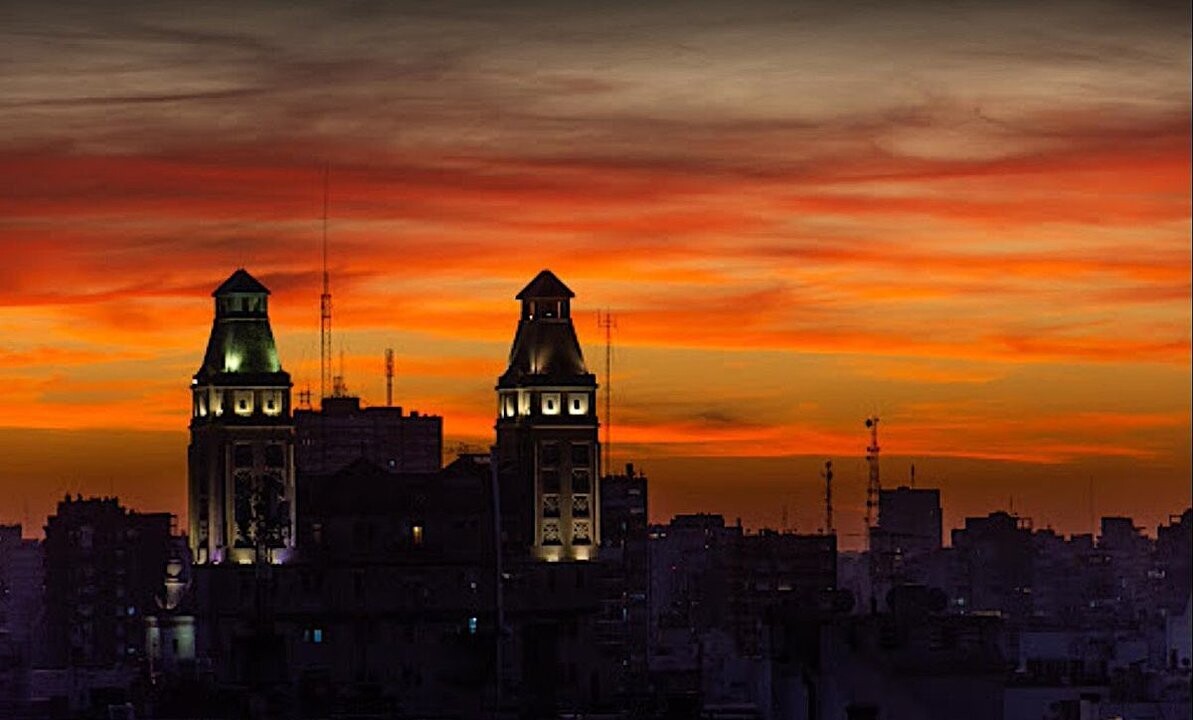
In the midst of the commercial fabric of Balvanera, one of the densest and least observed areas of Buenos Aires, stands one of the most singular buildings of 20th-century urban architecture: the Torre Saint.
Built between 1925 and 1928, this iconic work of porteño Art Deco is a testament to the aesthetic and technical ambitions of a city that, in those years, projected itself as a modern metropolis on an international scale. The building was commissioned by the entrepreneur Emilio Saint, heir to the traditional Águila chocolate factory, who promoted the development of a high-quality residential construction on what was then Cangallo Street — today Juan Domingo Perón — almost at the corner of Paso.
One of the building's sections suffered damage from a fire that occurred decades ago and remained unrestored for many years. Beyond its aesthetic value, the Torre Saint stood out from its origin for the quality of its materials and construction solutions. Marble, carpentry, and ironwork of European origin, along with details uncommon in collective housing of the era —such as air chambers between partition walls to improve acoustic insulation— demonstrated an advanced conception of residential comfort and life in a consortium.
In 2018, the building was restored as part of the “Once Peatonal” plan, promoted by the Government of the City of Buenos Aires, with the aim of recovering the architectural heritage of an area historically associated with wholesale trade. In an environment marked by the relentless pace of commerce, the building recalls a Buenos Aires that bet on architecture as a symbol of progress, identity, and cultural projection.
Its formal language belongs to the Art Deco movement, which emerged between the two world wars and found fertile ground for its development in Buenos Aires. The building's aesthetics also reflect the strong influence that archaeological discoveries in Egypt at the beginning of the 20th century had on art, design, and architecture of those years. This imprint is expressed in a profuse and eclectic ornamentation, where Egyptian-inspired pilasters, classical columns, Gothic buttresses, Greek urns, and Saxon-style pavilions coexist, integrated with the geometric lines characteristic of Deco.
The ensemble is crowned by twin domes that face inward into the block and are difficult to perceive from the sidewalk due to their location. To materialize the project, French architect Robert Charles Tiphaine and engineer Ítalo Galli were summoned, responsible for interpreting the most innovative architectural currents of the moment in a complex reinforced concrete structure for its time.
The Torre Saint was inaugurated in 1928 and quickly became an urban landmark. Currently, it has heritage protection through the Anchorena Law (No. 3056), which safeguards buildings constructed before 1941. Almost a century after its inauguration, the Torre Saint remains inhabited and stands as a key piece of porteño architectural heritage. The intervention included the restoration of the facades and towers, returning to the ensemble some of the lost luster due to the passage of time and lack of maintenance.